
When Hassan (not real name) arrived at Kazaure General Hospital in Jigawa State for testing after a routine consultation, Amina Tafida, an HIV Testing Services counsellor, guided him through pre-test counselling and conducted the test. When the result returned positive, Amina explained what it meant for his health and reassured him that care and support were available.
“People need to know that help is here and they’re not alone,” says Amina.
Through the Accelerating Control of the HIV Epidemic Project (ACE-2), implemented by Georgetown Global Health Nigeria (GGHN), counsellors are trained to turn one diagnosis into an opportunity to break the chain of HIV transmission. This approach, known as index testing, offers HIV testing to partners and biological children of people who test positive.
With this foundation, Amina introduced the next step: partner testing. Hassan hesitated at first, unsure how his wives would respond. Using skills gained through ACE-2 training and mentorship, Amina helped him see why testing the entire household was key to keeping his family safe. His concerns softened as their discussion continued.
“The health worker explained why it is better to know our status as a family so our children and unborn children can stay protected,” he recalls.
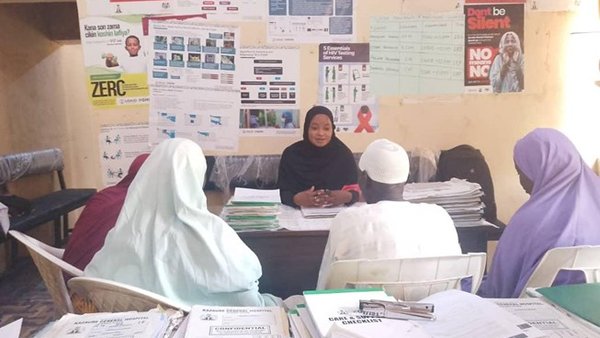
Amina sees her role as an HIV Testing Services counsellor as a way to make a real difference in the lives of the people she serves. “We were able to support the whole family and help protect the babies,” she said.
Later that same day, Hassan returned with one partner and her child. The partner tested positive and was linked to treatment immediately; the child tested negative and was enrolled for follow-up care. When Amina learned the partner was pregnant, she supported her to begin antenatal care quickly so she could access Prevention of Mother-to-Child Transmission (PMTCT) services.
A week later, Hassan came back with two more partners. Both tested positive. One of them was pregnant, and Amina worked closely with the PMTCT team to ensure she entered antenatal care without delay.
Across the two visits, four adults were newly identified and linked to treatment, while all children tested remained HIV negative, showing how index testing helps families access care they might otherwise miss.
In Q4 of this year, GGHN through ACE-2 carried out about 240,000 HIV tests across 91 supported facilities in Kano, Jigawa, and Bauchi states, identifying over 1,140 positive cases. This success was driven by approaches that focused HIV testing on partners and family members of people already diagnosed, while also integrating screening into maternal health, TB, and outpatient services. Alongside these testing strategies, ACE-2 maintained a strong linkage system, achieving 94% same-day ART initiation for newly diagnosed clients.
Amina sees her role as an HIV Testing Services counsellor as a way to make a real difference in the lives of the people she serves.
“We were able to support the whole family and help protect the babies,” she said.